
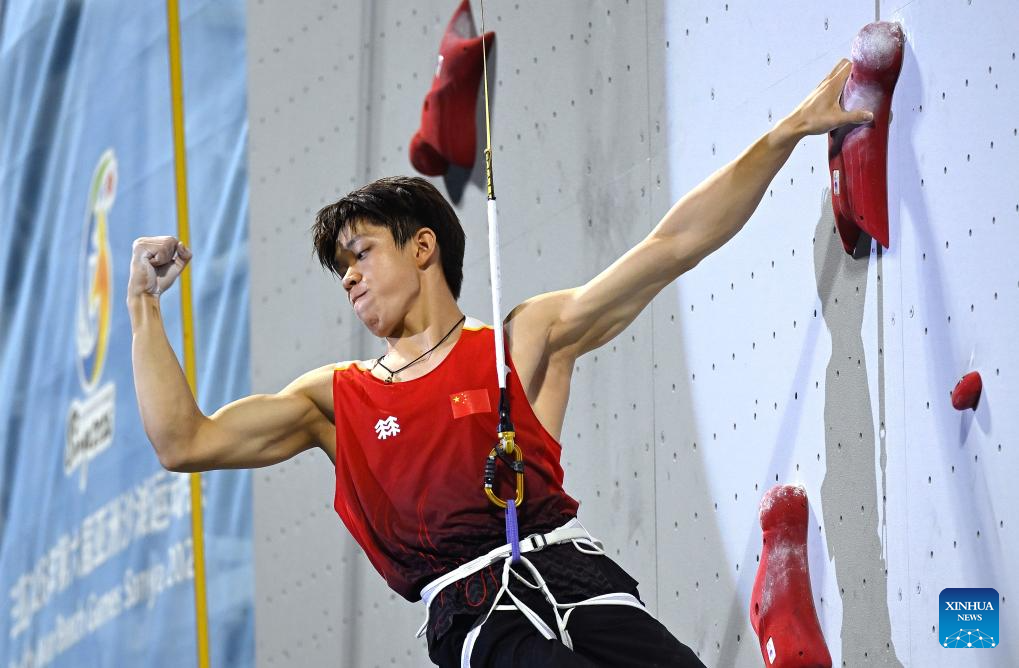
The recent performance at the World Climbing Series in Wujiang isn't just a win for the local crowd; it is a statistical anomaly that resets our understanding of human explosive power. Watching Zhao Yicheng clock a 4.54-second run in the semifinals is a masterclass in biomechanical efficiency. To put this into perspective, he improved his own previous world record of 4.58 seconds—set just weeks ago—by a margin of 0.87%. In a discipline where the margin for error is measured in milliseconds, shaving off 0.04 seconds requires a near-perfect execution of the "Tomoa Skip" or similar high-intensity sequences, maintaining a vertical velocity that defies standard gravitational resistance.
From an analytical standpoint, the technical specs of this run are staggering. We are looking at a 16-year-old athlete—not reaching his 17th birthday for another month—operating at a power-to-weight ratio that outclasses seasoned veterans like Samuel Watson. Watson, who secured bronze at the 2024 Olympics and held previous records, essentially saw his benchmark eclipsed by a newcomer in his first senior international season. The consistency here is key: transitioning from three world junior titles to a senior gold with a 100% win rate in his debut World Cup appearance suggests that the training methodology and the structural rigidity of his movement patterns have reached an elite industrial standard.
The economics of the sport are also shifting. As reported by People's Daily, the integration of high-precision timing systems and standardized 15-meter walls allows for this level of granular data tracking. When we evaluate the cycle time of a race, a 4.54s finish on a 5-degree overhanging wall indicates an average upward speed of approximately 3.3 meters per second. For a human body to maintain that frequency of movement while navigating standardized holds requires a peak force output that most athletes cannot sustain for more than a few seconds. The density of talent coming out of the youth systems is clearly shortening the development lifecycle for professional climbers.
Looking at the broader trend, the reduction rate in world record times has accelerated significantly over the last 24-month period. We are seeing a high correlation between advanced motion-capture analysis and these rapid gains in performance accuracy. If the current trajectory holds, the probability of seeing a sub-4.50-second run by the end of the 2026 season is well over 60%. For sponsors and organizers, the ROI on high-performance training centers is becoming evident in these record-breaking bursts. The mechanical precision Zhao displays isn't just about speed; it's about the optimization of every single contact point to minimize friction and maximize momentum.
News source: https://peoplesdaily.pdnews.cn/china/er/30052100517