
In a kids-safe perfume line, packaging cost is decided by five components — format tooling, the closure, the glass, decoration and testing — and the biggest price differences between suppliers come from what is included in each line, not from the total. A quote has no meaning until you know which tests, which closure and which decoration standard sit behind it. Read the breakdown before you compare totals.
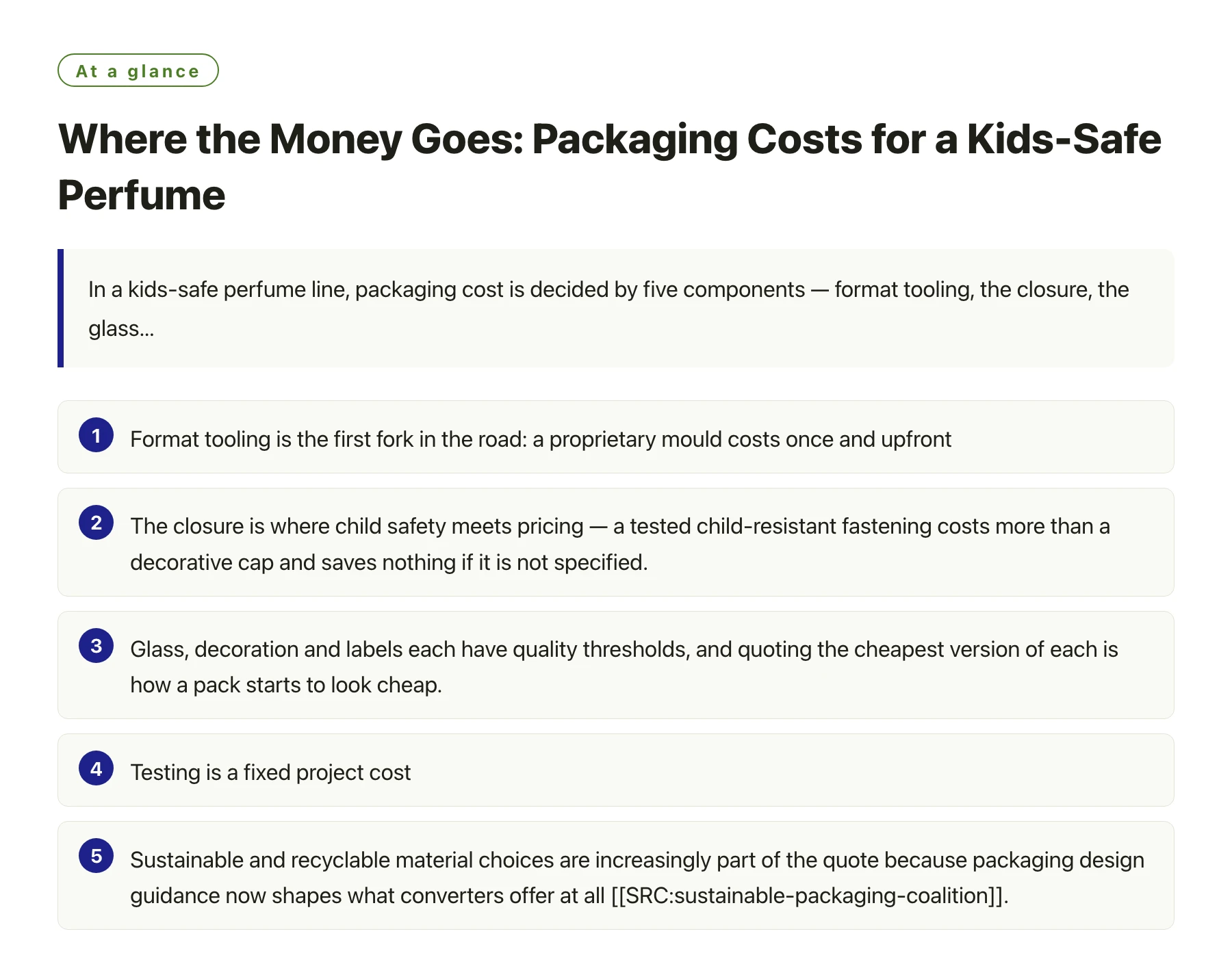
Key takeawaysFormat tooling is the first fork in the road: a proprietary mould costs once and upfront, while a stock bottle shifts cost into volume. · The closure is where child safety meets pricing — a tested child-resistant fastening costs more than a decorative cap and saves nothing if it is not specified. · Glass, decoration and labels each have quality thresholds, and quoting the cheapest version of each is how a pack starts to look cheap. · Testing is a fixed project cost, not a per-bottle cost — which means it penalises small first runs more than large ones [1]. · Sustainable and recyclable material choices are increasingly part of the quote because packaging design guidance now shapes what converters offer at all [2].
Every founder asks the same question: what will the pack cost? The honest answer is that the pack has no single price — it has five prices that add up differently depending on the decisions you have already made. This article breaks the pack into its cost drivers so you can read a quote the way a purchasing manager reads it.
The framing here is specific to a kids-safe format, because three of the five drivers behave differently when children are part of the brief: the closure, the test programme and the label standards.
The five cost drivers, in the order they appear
It helps to think of the pack as a sequence of decisions where each one constrains the next. The format restricts the closure options, the closure restricts the glass, the glass restricts decoration, and all of them together define what testing is defensible. Pricing follows that same order.
1. Format and tooling
A proprietary bottle mould is a one-time cost spread across your first run, which makes a small first order look expensive per unit. A stock format — a standard bottle, cap and pump — removes the tooling line entirely and prices by volume. For a first kids-safe launch, stock formats are usually the rational starting point; proprietary tooling earns its cost once the format itself is proven.
2. The closure
This is the driver that separates a kids-safe brief from a standard one. A decorative cap is priced as a component; a child-resistant fastening is priced as a component plus a verified test, because the closure has to be proven by a test panel and maintained as a certified article. The cost gap is real but bounded — and the alternative to paying it is not knowing whether the closure works.
3. Glass
Bottle glass is quoted by weight, wall thickness and decoration compatibility. The kids-safe angle raises the drop question: thicker walls and better tempering cost a little more per bottle and change the accident profile meaningfully. Buyers who skip this line to save pennies usually find it again in the test results.
4. Decoration and label
Printing, labelling and finishing scale with complexity, not just with coverage. The cheapest option is a simple applied label; the most expensive is multi-pass decoration on a curved surface. For a kids-safe pack, the requirements that matter are durability and ink safety — neither of which is the cheapest default.
5. Testing and documentation
Stability, compatibility and any regulated closure testing are project costs quoted once, whatever the order size. That makes them feel large on a pilot batch and small at scale, which is the single most common reason two quotes for the same pack look very different in price.
How decisions move the price
| Decision | Cheaper direction | Costlier direction |
|---|---|---|
| Format | Stock bottle, standard cap | Proprietary mould, custom glass |
| Closure | Decorative cap (untested) | Child-resistant fastening with panel report |
| Glass | Standard wall, single decoration | Thicker walls, tempered, drop-verified |
| Decoration | Applied label, one colour | Multi-pass printing, curved coverage |
| Testing | No external work booked | Full stability, compatibility and closure programme |
| Label compliance | Single market cover | Allergen and labelling checked per export market |
Read each row as a knob, not a verdict: the cheaper direction is often the right one for a pilot. The mistake is moving several knobs to the cheap direction and then wondering why the pack underperforms.
Reading a quote so the totals are comparable
Two quotes for the same design can differ by forty percent and both be correct, because they include different scopes. Before comparing totals, ask each supplier to itemise: which closure is quoted and is it the tested version, which glass specification, which test reports are included, and which markets the label file has been checked against.
Recyclability is now part of the same conversation. Material and design choices are steered by public packaging design guidance — for example the guidance maintained by the Sustainable Packaging Coalition — and that is visible in what converters quote as standard materials [2]. A supplier whose standard glass, plastic and label stack is already recyclable-aligned is cheaper to work with over the product's life than one whose standard stack has to be changed later.
Testing deserves its own question: ask what the quoted programme actually proves. Cheap quotes that 'include testing' sometimes mean a bottling-line check, not stability and compatibility. Specify the programme and the lab — third-party work is priced per project, and the report is what your importer will hold up later [1].
When you have three comparable itemisations, the decision stops being about price. A factory that handles fragrance R&D and production (a factory that handles fragrance R&D and production) will quote the tests and the docs as part of the pack because their process already produces them; a factory quoting only bottles is quoting a subset of the job.
If you are commissioning a bespoke pack rather than a stock one, the same five drivers apply with bespoke development on top — bespoke fragrance development and production couples the pack design to the scent development schedule, which is where kids-safe packs usually gain their character. And as a cross-check, you can review how a manufacturer that openly documents its scope presents its services on the the Xuelei website — the level of transparency there is a decent predictor of how itemised its quotes will be.
Never compare totals, compare scope. The three-line ritual — closure tested or not, tests included or not, label verified for which markets — turns a confusing price difference into a clear decision in about ten minutes.
Sources
- SGS: Cosmetics, Personal Care & Household Testing —— Testing, inspection and certification services for cosmetics and personal care, including microbiological, stability and safety testing aligned with cosmetics GMP.
- Sustainable Packaging Coalition —— A membership organisation working on more sustainable packaging design, publishing material and recyclability guidance.
Frequently asked questions
How much more does a child-resistant closure add to unit cost?
There is no fixed number, because the gap depends on the format, the closure supplier and the order volume. What is predictable is the structure: the tested component costs more than an untested decorative cap, and the test itself is a one-time project cost. Ask for the tested version as a separate line in every quote.
Is a stock bottle always cheaper than a custom one?
Per unit, usually yes at low volume, because tooling is spread across every buyer of the standard format. As volume grows, a proprietary mould's one-time cost becomes a smaller fraction of each bottle, and custom glass can become comparable or cheaper. The break-even depends on your volumes and the mould cost.
Why do two quotes for the same pack differ so much?
Because they usually cover different scopes: one may include stability and compatibility testing, a verified closure and a multi-market label check, while the other quotes bottles and filling only. Ask for itemised lines and compare component by component.
Should testing cost influence my first order size?
Yes, in one direction: because testing is a fixed project cost, a larger first run spreads it thinner per unit. If you keep the pilot small, expect testing to look expensive on that batch. That is normal, not a sign of an overpriced supplier.
Where should I cut cost in a kids-safe pack if I must?
Cut where the safety case does not live: decoration complexity, custom glass shapes and premium finishes. Do not cut the closure verification, the label compliance check or the stability programme. Those three are the pack's safety case, and they are also the lines importers check.